
‘For never anything can be amiss / When simpleness and duty tender it.”
This line is spoken by “A Midsummer Night’s Dream’s” Theseus, just before watching a play performed by a motley band of earnest local actors. I carried this quote home from the opening night of “Midsummer,” presented by the Madera Theatre Project (MTP). It seemed to apply to the very production in which the words were uttered. Directed by Austin Yarbrough, this “Midsummer” (through June 22 at the Matilda Torres High School Performing Arts Center) is a simple and dutiful staging of one of Shakespeare’s most popular plays, walking a line between community theater and youth theater camp.
The ‘Dream’
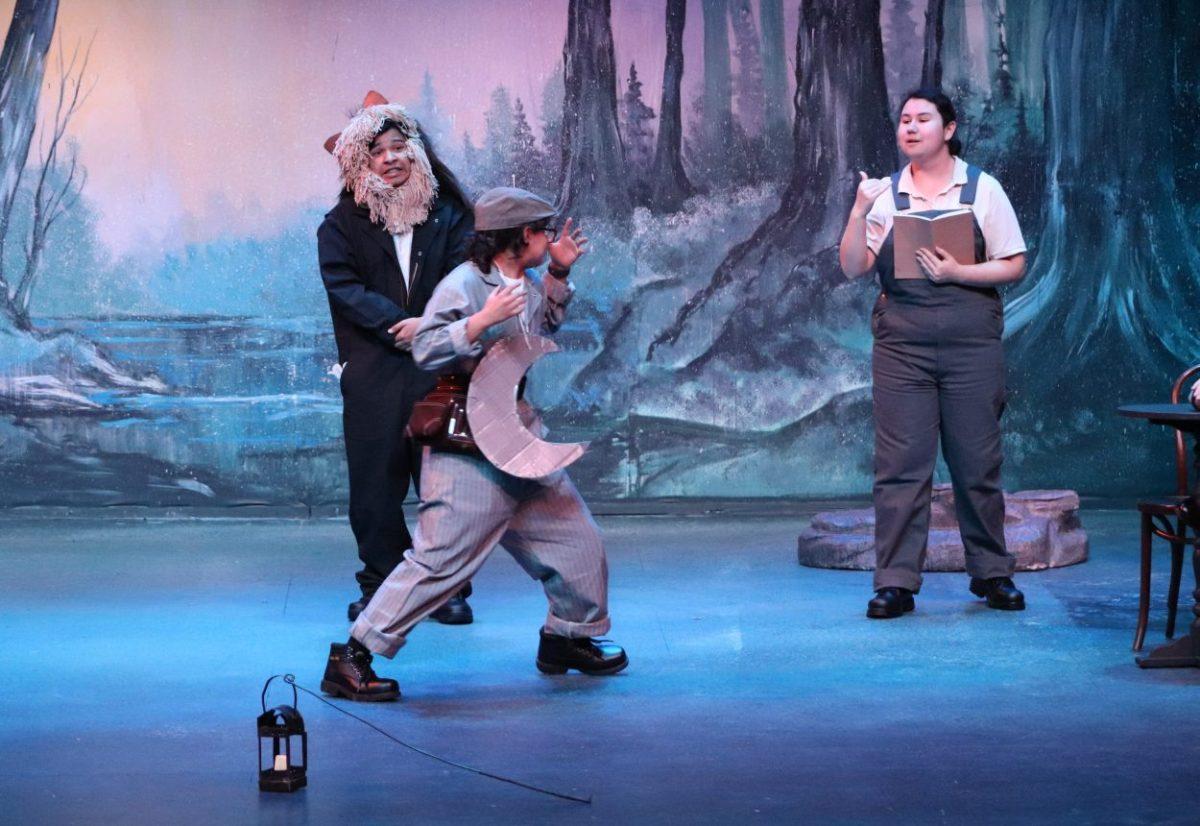
“A Midsummer Night’s Dream” offers up a veritable menu of Shakespeare’s jovial tropes: thwarted lovers, rowing royalty, lowbrow comedy, magic, mischief, and long walks through the woods. In this iteration, it is the straight-laced 1950s. On the eve of a grand wedding between lord of the manor Theseus (also played by Yarbrough with a dripping southern drawl and a golf swing) and Hippolyta (an elegantly composed Samantha Ramos), Hermia and Lysander (Cynthia Aldepe and Trevon Gaddis) elope to the woods in defiance of her imposing father (Jason Rogers). Following them is Demetrius (Thomas Estrada) who is in love with Hermia. Following him is Helena (Molly Smith), Hermia’ s best friend and admirer of Lysander. And yes, this gets zanily complicated once the rules of society melt away on the journey.
Meanwhile, in the fairy world, King Oberon (Wayman Milam) and Queen Titania (Zoë Guzman) plunge their courts into battle, creating disorder in the natural world. Their tumult sets havoc after mayhem on anyone who gets in their way.
Also in the woods, a group of unsophisticated locals (“the Mechanicals”) rehearse a play they intend to offer as entertainment for Theseus. Led by Nick Bottom (a robust Carlos Sanchez), the cast struggles to get organized, especially when Bottom goes missing.
It is a veritable magical soap opera with the highest stakes possible in this world: Freedom, power, love, respect, and a happy-ever-after. While this production has a lot of potential, it doesn’t quite rise to the all-or-nothing struggle required of Shakespearean plots.
‘It is not enough to speak, but to speak true’
One of the production’s strengths lies in its commitment to training the inexperienced cast in Shakespearean language and its delivery. I give full marks on the language coaching here. The cast delivers the words with confidence and clear understanding. However, this proficiency runs afoul of the overly rapid delivery of lines, which compromises clarity and diction. It also doesn’t allow for variations in rhythm, pace, or style. As such, much of the acting cannot explore beyond surface gestures and often falls short of achieving the intense emotional urgency needed from the characters.
The Munro Review has no paywall but is financially supported by readers who believe in its non-profit mission of bringing professional arts journalism to the central San Joaquin Valley. You can help by signing up for a monthly recurring paid membership or make a one-time donation of as little as $3. All memberships and donations are tax-deductible.
Standout performances come from the more experienced cast members, young though they may be. Gaddis as Lysander and Estrada as Demetrius inject the play with linguistic playfulness. The pivotal scene involving the lovers’ fight showcases the highest urgency of the production, fueled by the rivals’ physical comedy. It is nicely acted and directed and achieves the most earned laughs of the night.
Sanchez is also adept as Bottom, a character of more assurance than brains. He delivers a funny performance that has the potential to go further than it can here. Also of note is Noel Galindo as Flute/Thisbe whose final moments of the wedding play show real promise as a performer.
‘Take pains. Be perfect.’
The portrayal of the fairies’ world, however, tends towards a more literal and pedestrian interpretation. While Milam and Guzman possess melodious voices, Yarbrough’s direction of their fairy courts lacks the chaotic whimsy needed for the topsy-turvy danger of this unpredictable world. Instead, it presents as a controlled and orderly procession in every scene.
But the production is also lovely at times. The scenic design by Christina McCollam Martinez and Antonio Olivera III features a beautiful backdrop depicting the Redwood fairy forest from Griselda Tello Yarbrough. The lighting design (Marc Petros) and sound design (PJ Galegos) enhance the magical elements of the plot without distracting fanfare. All-in-all, the staging, action, and approach offer up this “Dream” rather literally, in the easy-to-understand way of youth theatre. Given this and a predominantly inexperienced cast, this Dream doesn’t quite live up to the fantasy.
The Matilda Torres Performing Arts Center, however, provides a comfortable venue with ample parking and is easily accessible from Highway 99. The student front-of-house crew were friendly and helpful (shoutout to our usher, Myles!). However, the 7 p.m. start time may cater more towards family audiences, so adjust your drive time accordingly.
“A Midsummer Night’s Dream” continues through June 22 at the Matilda Torres Performing Arts Center in Madera.
Educational theater or community theater?
Madera Theatre Project is a collaboration between the Madera Unified School District and the Madera Arts Council, so “A Midsummer Night’s Dream” presents me with some questions. I try to respond to a production based on its intended audience, apparent artistic goals, and how well it achieves them. But with the Project offered partly by the local schools and partly by the arts council, I’m unclear on who this production is for.
With a cast predominantly composed of high school students, supported by only a handful of adults or college-age actors, and directed by an educator who puts that role first, the production straddles the line between an extended educational opportunity for local students and a community arts showcase. The results offer a production that would be an excellent high school staging of the play, but leaves out the depth and texture that a cast with more experience and variety might have offered. If this is the purpose, perhaps designating one or two productions a season specifically for giving high school age students experience is in order. Then the others can focus on a broader community theater cast.
Heather Parish (@heatherdparish) is a recovering thespian and cheery misanthrope returning to her first love of scribbling after decades of cheating with theater. For twenty-five years, Heather produced and directed a variety of theatre, from Shakespeare in the Park to black-box indie, from classics to fringe. Heather also writes essays and zines combining DIY information with creative non-fiction.