The Bee’s Rory Appleton has an interesting piece about something new for audience members at the Saroyan Theatre: bag checks and metal detectors. The practice is part of a larger trend of increased security at the Save Mart Center, Selland Arena and other local venues.
Appleton writes:
A series of unrelated events both in Fresno and abroad have led many of the local venues to tighten up their bag policies. Some also have added metal detectors to their entrance routines. Both are a byproduct of 2017 life, but both have led to long entrance lines for everything from rock concerts and symphony performances to San Joaquin Valley Town Hall events.
My first encounter with the Saroyan’s new security policy was the long line to get into the Fresno Philharmonic’s opening pops concert of the season on Saturday night. When I arrived at about 7:20 p.m., 10 minutes before the concert was to begin, the line to get into the south entrance stretched almost to the parking garage.
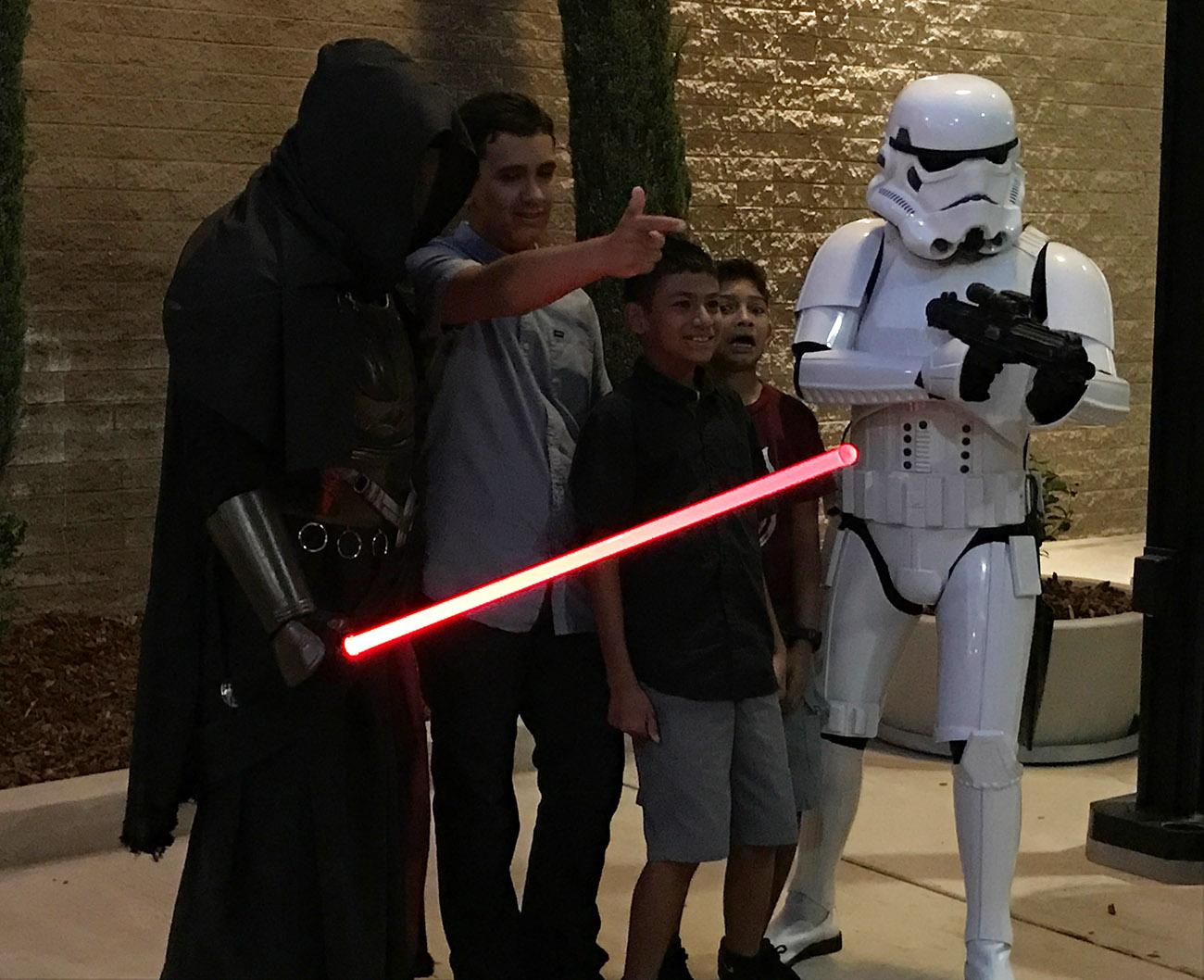
Luckily, thanks to the theme of the concert, there were “Star Wars” characters in costume wandering up and down the line entertaining folks. There’s nothing like a dour-expression-flashing imperial stormtrooper to keep your mind off the fact that our country’s own security-industrial-complex infrastructure keeps growing in new and disturbing ways. Now, it seems, a metal detector is necessary to gather in a public space to listen to the music of John Williams. (The bag check requirement was waived this time around, The Bee tells us, but it will be in place for the orchestra’s first Masterworks concert on Oct. 15.)
It turns out there wasn’t enough time for the whole crowd to go through the metal detector, or else the concert would have started impossibly late. When I arrived at the door, I was told to walk right in. This would seem to defeat the idea of increased security, unless you’re assuming that terrorists are early birds.
Still, despite the hiccups, the Saroyan security procedure is in the developmental phases. I’m sure the process will become smoother. (First order of business, I’m assuming, is more metal detectors and personnel to speed up the lines.) But that smoothness — the point where it’s all just one more hassle we go through in daily life, a few more minutes wasted in the name of pro forma reassurance — is what I get nervous about.
I understand the impulse for ever-more security. The Ariana Grande concert tragedy in England certainly has folks on edge. So does the stream of stories about other attacks overseas.
I also know what it’s like to be in a city that feels under siege. I lived in New York in 2002-03, and I experienced my fair share of bag checks and metal detectors at everywhere from the Metropolitan Opera to the Metropolitan Museum.
But that was New York. This is Fresno. How much do we want to cede our daily lives to exaggerated vigilance?
To me, the most troubling thing is this: The individual rights we give up in the name of security will be very hard, if not impossible, to ever claw back. Example: We’ve slowly become accustomed to the rigorous security drama we go through when we board our airplanes. (And in some cases, as with the prohibition on bottled water, that rigor is aimed at infinitesimal risks.) We’ve become resigned to the irritation, inconvenience and humiliation.
There’s always someone who says: “Well, if there’s a chance something bad could happen, we need to be vigilant.” You might think that’s a reasonable argument. But it’s problematic. There’s always something more we could do to reduce risk. How far are we willing to go in the name of security? Road blocks at random intersections? (We already do that in the pursuit of elevated blood alcohol levels.) Metal detectors at the grocery store? Will we tolerate random frisks and spot checks at ArtHop or Fig Gig or farmers’ markets?
It’s fun to see people dress up as futuristic fighters bristling with space-age weapons. Yet as I watched the agents of the evil Empire strut up and down the line at the Fresno Philharmonic event, I thought about real soldiers with real guns guarding and screening us, and it didn’t seem so festive. What if this becomes normal in terms of the way we experience public space? Will it come to that?
I don’t have any easy answers. But I do know that I’m annoyed. And concerned. And resigned to arriving 15 minutes earlier.
To subscribe to the email newsletter for The Munro Review, go to this link:
https://tinyletter.com/donaldfresnoarts