

In a move that could disrupt the first-ever Measure P arts grants, the city’s Parks, Recreation and Arts Commission will meet for “reconsideration” of grant “award amounts” that the Commission approved only one month ago. The special meeting is scheduled for 5:30 p.m. on July 1 at City Hall.
What prompted the Commission to schedule the July 1 meeting and what “reconsideration” means are questions that key officials either aren’t answering or say they don’t have answers for. One key person – Kimberly McCoy, chair of the Commission and designated as one of its media spokespersons – did not respond to a Facebook message, text or voicemail from The Munro Review.
Links to Measure P grant recommendations
General Operating Support for Established Organizations
Project Specific Support for Established Organizations
General Operating Support for Emerging Organizations
Project Specific Support for Emerging Organizations
Fresno Arts Council May 20 draft presentation to Parks, Recreation and Arts Commission
Meanwhile, Commissioner Jose Leon Barraza told The Munro Review that “corrective action” could be necessary if residents in south Fresno aren’t getting equal benefit from the Measure P grants that the Parks, Recreation and Arts Commission approved on May 20. City staff is preparing a report on that subject, which is scheduled to be completed by July 1.
Could reconsideration involve changing the grant amounts that successful applicants expect to receive after the Commission acted on May 20? Barraza said until the report is finished it would be premature to discuss how “corrective action” might affect the reconsideration of the grant awards.
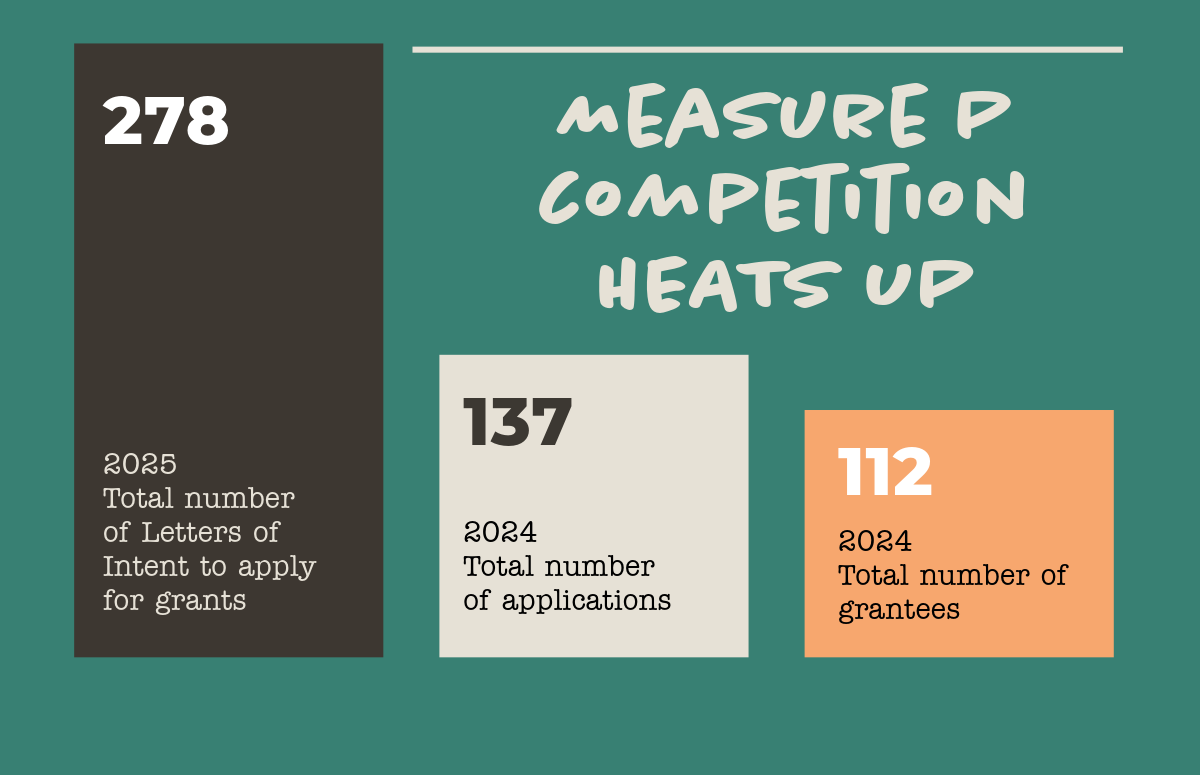
The unanswered questions could be unsettling for the more than 70 nonprofit arts organizations and individual artists with eligible fiscal sponsors that anticipate receiving grants totaling $8.7 million because of Commission votes on May 20. Those awardees have not yet signed contracts necessary to receive the Measure P money, a fact that could add to their angst.
One awardee, Amy Kitchener, executive director of the Alliance for California Traditional Arts, told The Munro Review it’s not unheard of for public funders to make adjustments after an “intent to award” is announced and before contracts are finalized. She added that her organization once sought a grant where process problems led to a do-over even after grant amounts were announced to applicants.
Kitchener said the Parks, Recreation and Arts Commission is in a “difficult situation” because she believes Barraza’s questions about equity are valid, as are the concerns of applicants unsettled by the idea of reconsideration.
The Munro Review spoke to another awardee who asked to remain anonymous to avoid creating problems with their Measure P grant. “While the Commission’s desire to have more information about the Measure P grant awards is understandable, there has been a frustrating lack of communication to grantees about the process,” the person said.
“Grant awardees have received no information about the July 1 special meeting or whether previously announced award amounts might be changed. This makes it difficult for interested parties to participate meaningfully in the process before the [Commission.]”
Recent Measure P coverage:
DOWNTOWN FRESNO PARTNERSHIP AND LAOTIAN DANCE GROUP PUSH BACK AGAINST FRESNO ARTS COUNCIL OVER MEASURE P GRANTS
And: MEASURE P GRANT RECOMMENDATIONS APPROVED BY FRESNO CITY COMMISSION
And: AS SELECTION PROCESS FOR MEASURE P GRANTS BEGINS, THE MUNRO REVIEW ASKS FOR OPENNESS
And: WITH AN OCEAN OF TAXPAYER MONEY AVAILABLE, MEASURE P ARTS FUNDING IS SURE TO RAISE COMPETITION AND QUESTIONS
And: GROWING PAINS: IS FRESNO CITY COUNCIL MICROMANAGING MEASURE P ARTS FUNDING?
How much Commissioners and other key officials know about the July 1 meeting is unclear. The Munro Review emailed Commissioner Laura Ward, who serves on the Commission’s cultural arts subcommittee, and asked whether grant amounts approved on May 20 might be changed at the July 1 meeting. “I don’t have that information,” she replied.
Commissioner Scott Miller, who also serves on the cultural arts subcommittee, did not respond to an email with questions. That subcommittee has taken a lead role in helping craft the grant program and its guidelines.
The Munro Review also emailed questions to Lilia Gonzáles Chávez, executive director of the Fresno Arts Council, which administers the grants program. She replied: “I received the same information you did at the [June 17] meeting.” Gonzáles Chávez later added: “I only know what was said at the meeting.”
The Munro Review sent questions to city spokesperson Sontaya Rose and also through her office to city parks director Aaron Aguirre. Neither responded. The parks department provides staff to the Parks, Recreation and Arts Commission.
Commissioner Barraza said in an interview that he expects the agenda for the July 1 meeting will include a discussion about “the allocation and distribution” of the Measure P grants approved on May 20. On May 20, Barraza voted against the allocation and distribution recommended by the Arts Council.
On May 20, Barraza praised the work of the Fresno Arts Council in administering the grants program, but added: “We also have a fiduciary responsibility to make sure that we can explain to the world that this is a good investment.” He spoke about ensuring Measure P arts grants provide “equity,” which involves “all communities [having] access to the process,” specifically southeast, southwest and south central Fresno.
To determine if equity exists, Barraza has asked that the report being compiled by city staff show in which city council districts the awardees have addresses plus the amount of grant money each awardee is slated to receive. The Commission also wants some details on how awardees would spend their Measure P money, according to the motion calling for the July 1 special meeting.
If the report shows inequity for south Fresno, Barraza said, “I would definitely expect steps to remedy the deficiencies in funding.” Whether that could lead to spending approximately $800,000 in unallocated Measure P funds is an open question, Barraza said. The $800,000 is the difference between the $9.5 million budgeted by the Fresno City Council for Measure P arts grants in 2024 and the $8.7 million allocated by the Commission.
Whatever solution is decided upon, it should be “fair” to the more than 70 awardees who were approved for grants in May, Barraza said. “It’s not simple. I hesitate to be very specific because we don’t know what we’re dealing with” regarding the equity report on south Fresno.
One additional factor could come into play on July 1: the appeals from two applicants dissatisfied with how their applications were handled. The Commission has delayed hearing those appeals on guidance from the City Attorney’s office, parks director Aguirre said at the Commission’s June 17 meeting. There is a “procedural issue” and the City Attorney’s Office “requested us to work on the curing process” before proceeding with the appeals, he said.
One appeal is from Choummaly Keodara, who teaches and leads a Laotian youth dance group in Fresno. Keodara requested $35,000 but was recommended to receive no money.
The other appeal is from the Downtown Fresno Partnership, an organization that promotes the economic wellbeing of the city’s central core. The Downtown Partnership has objected to the Fresno Arts Council rejecting five of its six grant applications.
An attorney for the Downtown Fresno Partnership sent a pointed letter in May to City Attorney Andrew Janz. In the letter, the attorney asserted the Downtown Partnership’s “procedural due process” had been violated because the Arts Council – on behalf of the Parks, Recreation and Arts Commission – imposed a limit on project applications, which caused five of the Partnership’s applications to be rejected. Furthermore, the attorney said, the limit does not exist in grant guidelines approved by the Fresno City Council and which the Downtown Partnership knew nothing about. The attorney asked the city to take corrective action so all the Downtown Partnership’s grant applications could “be considered on their merits.”
Fresno voters approved Measure P in 2018. It raised the city’s sales tax by 3/8 of a cent for 30 years to generate millions of dollars to boost parks (they received 88% of the funding) and the arts (receiving the remaining 12%). The six-year delay in arts funding is due to a legal fight that followed the initiative’s passage, and once that was successfully resolved, bureaucratic wrangling at City Hall over the arts grants.
Doug Hoagland is a freelance writer in Fresno. He spent 40 years working at Valley papers, including 30 years at The Fresno Bee. The first play he saw was a 1968 production of “Show Boat” at McLane High School.

Jen • Jun 25, 2024 at 4:30 pm
Awesome reporting, Doug. Your thoroughness in this series of articles is so very appreciated. I especially commend your followup letters and questions and requests for comments and explanations.
It’s amazing that these folk seem to think they can change the rules and make it up as they go along. There needs to be an accounting to both the artists applying for grants and to the taxpayers who are paying the bill. It will be very interesting to see how the grants map out across town.
Thank you for your efforts to make the process transparent.
Steph • Jun 24, 2024 at 5:07 pm
Our money + governmental processes x lawyers (lots of lawyers) – transparency = no money
Our money = no money, no explanations
Put together a non-governmental committee to allocate funds = 5+ year process. Committee finally gets to review and score applications. Citizen committee makes decisions allotted to them.
But our money + governmental intrusions x lawyers (lots of them) – transparent = no money.
Repeat ad nauseum.
Ridiculous.