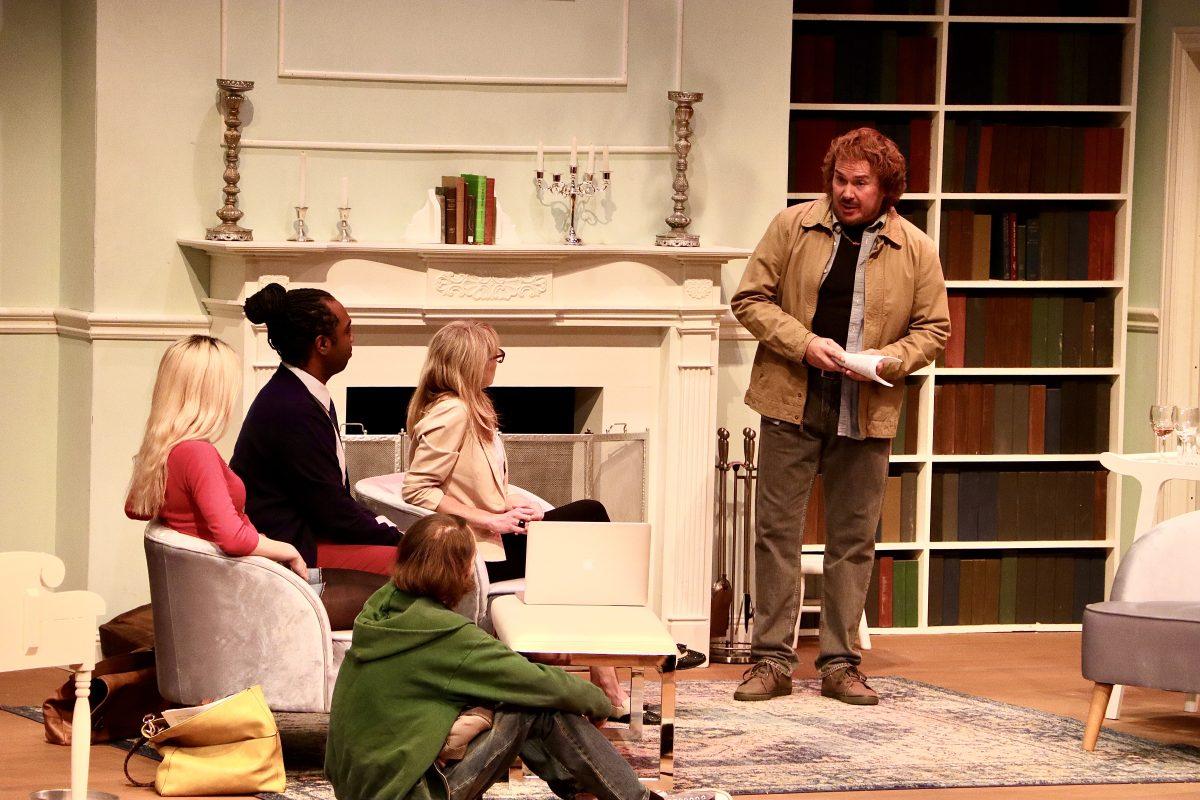
resno State’s mainstage production of “Seminar” did not have a smooth pre-opening experience. On Wednesday, contractors working on the university’s infernal campuswide infrastructure project caused an accident that flooded the basement of the Speech Arts building, which houses the theater department. Along with flooding the costume shop, the event also cut power to the building and kept director Brad Myers and his cast and crew from holding dress rehearsals in the theater itself. (The Collegian has a good story explaining what happened.)
But the play goes on. The university brought in generators to power the John Wright Theatre over the weekend.
I caught up with director Brad Myers before the power outage:
Q: I know that Theresa Rebeck is a big-name playwright. Have you directed anything by her before?
A: I have never directed a Rebeck play before. I have always appreciated her complex characters and compelling circumstances, and have frequently used scenes from her plays in my acting classes. I have proposed “Seminar” for previous University Theatre seasons multiple times. However, the small cast size suggested that it should more appropriately be presented in the Woods Theatre. But some major scenic demands required that it be staged in the larger John Wright Theatre. Finally my colleagues agreed to produce this intimate adult play with lavish production values in our December slot. I am so appreciative of the actors in this production who are superbly filling the larger space with the fullness of the lives Theresa Rebek has created.
Q: Leonard, the novelist who sells his advice to aspiring writers in “Seminar,” is a difficult guy. Have you known any Leonards in your theater career?
A: In graduate school I had one professor who was committed to being truthful — often at the expense of popularity with his students. Many times I cursed his name as I drifted off to sleep, but an inner voice urged me to never miss one of his classes. Many years later, I consider him the most impactful influence on my artistic development.
Q: You’ve said you identify with the play as an artist, student and teacher. Let’s start with the student part. As a student, were you ever crushed by a critique?
A: I do not have an undergraduate degree in theater, so my early training largely came from having performed in many summer stock musicals and comedies. I took a semester off to tour as a singer/dancer in a USO show. When I started grad school, I was a showman and nothing more. After he had seen me give a particularly phony audition, the previously mentioned grad school professor told me that he never believed anything he had ever seen me do on stage, and told me to quit hiding behind a “well-rehearsed bag of tricks.” He said there was nothing personal in my acting and I was too obsessed with being liked on stage. I was cast a lot and thought I was an obvious super-talent. I was knocked back onto my heels and immediately ran to my fellow classmates for validation of my hollow acting. I discovered a cautious reserve in their responses, and decided to commit to working on more self-betrayal in my work. During the two years after receiving that criticism I believe I grew the most as an actor.
Q: As a teacher, you don’t want to discourage students to the point they give up. But you also want to make them better. Are you tougher on some students than others because you know the strong ones can take it?
A: I believe every student is entitled to train to improve. But seeing an acting student with true professional potential is exhilarating. And yes, I will frequently push that student harder than others. I often tell my students that if I’m not challenging them I’m not doing my job. And often challenges can be frustrating.
Q: As an artist — and this is getting philosophical here — can someone really help you get better? Or does it have to be within the artist’s own self?
A: An innate talent is essential for an actor with professional aspirations. You can’t teach talent. You can only help to minimize the barriers which prevent that talent from surfacing. I don’t try to teach tricks and gimmicks which will mask the absence of talent.
The other unlearnable ingredient is passion. Usually the student without passion is hoping to learn short cuts to make the artistic endeavor easy. I don’t know any.
I try to validate a fascination for the world around us and discourage an actor’s self obsession. Sir Laurence Olivier once described actors as “students of mankind.” That has always stayed with me.
Q: What is the best advice/critique you ever received as a student?
My MFA Is in acting and directing. The criticism I received in graduate school that most resonates with me today, was that I had an inability to tolerate chaos in the creative process. I still have to check my tendency to be a control freak when both directing and acting.
Q: And what is the worst?
A: In undergraduate school I was on the debate and forensics team. My coach for this team attended many of the performances I gave and finally concluded that I should pursue law school because I was a better debater than actor, and I’d make a lot more money as an attorney.
Q: Anything else about “Seminar” you’d like to say?
“Seminar” is double cast, and both casts are worth seeing. They are not mirror images of one another.
Even though “Seminar” is a comedy, it contains adult language and explores mature themes. If you need something other than seasonal froth over the holidays, then “Seminar” is your ticket.