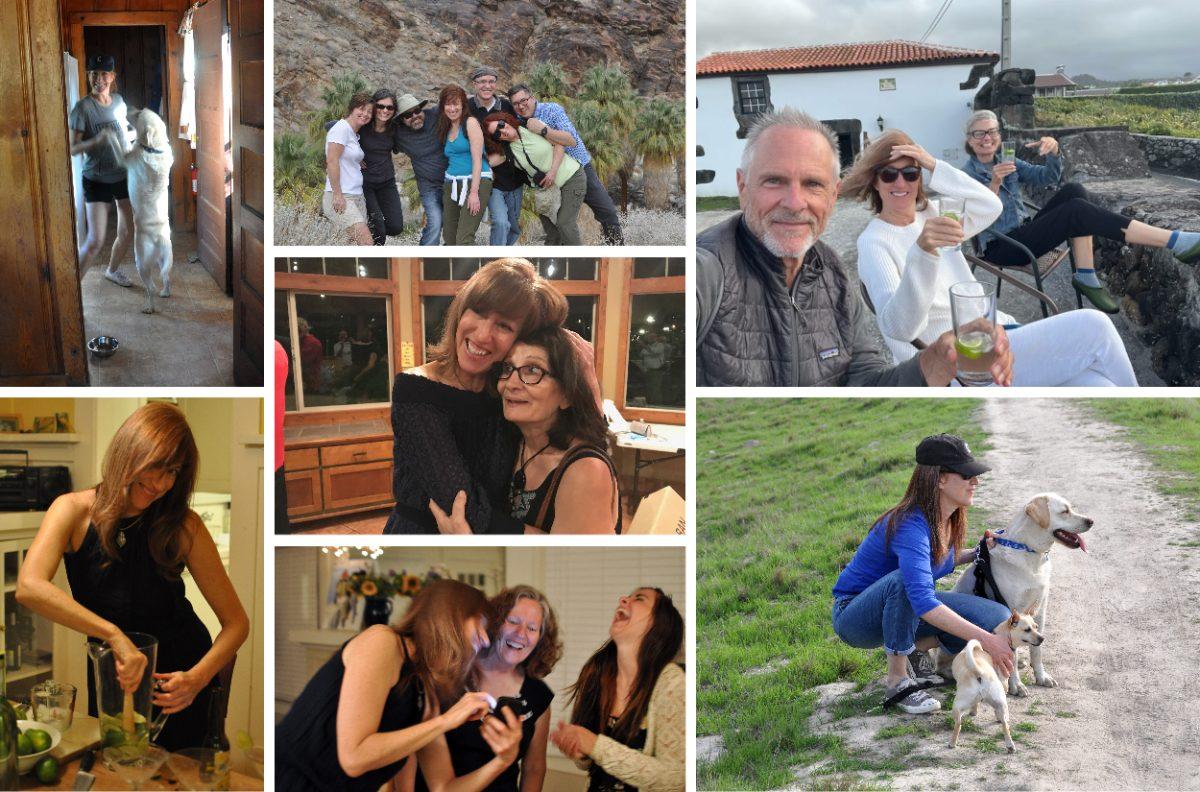
lost a dear friend last night. Diana Marcum slipped away from us far too soon.
Known to the Valley for years as a vivid and passionate storyteller for the Fresno Bee, she moved up the career ladder to do the same kind of writing for Los Angeles Times. But even when she switched newspapers, she didn’t leave town. She continued living in the same little Tower District bungalow with the yellow dining room and the big blue painting on the wall. She won a Pulitzer Prize for feature writing and traveled to New York City to accept the award at Columbia University, and I know that deep down she got a kick out of offering a small but pointed shushing to those who say you need a fancy-college degree to make it in this world. She published two well-received books, both sorta memoirs, one about her beloved island of Terceira in the Azores, where she tracked and mingled with the great Azorean Portuguese diaspora that fascinated her so, the other book set in the most unlikely of places: an out-of-the-way butterfly farm in Belize.

Diana’s life sometimes felt like that abrupt shift in subject matter between her two books. Even though she stayed in the same house for many years, I always thought of her as someone who couldn’t be tied down. Many was the editor who tried to corral her, wild-horse-style, and make her conform to the business-hours-and-spreadsheet uniformity of professional journalism. A few of those editors tried to break her. But in the end, her ferocious talent with words was able to procure for her an all-access pass to do the writing she loved: telling stories about regular people.
I will leave it to others to provide the chronology and accomplishments of her life. As her former next-door-neighbor and hearty friend, I’m too close (and sad) to do the summing-up thing that is part of my usual repertoire. For me, our years together blur into a composite of walking doted-upon dogs, trading newsroom gossip, cataloging our days. As a journalist you’re always meeting new acquaintances, and Diana took a great delight in sizing up the day’s crop. Bland, pretty people bored her; she loved describing awkward faces and harumphing voices and unfortunate choices in leisure wear. But it wasn’t meanness that led to her honesty while narrating her daily life. She saw every new person she met as a potential gem of a character in the big, swirling nebulae of an always forming novel – her life – going through her head.

I mention the word narrate. That was an important word for her. She was an evangelist for the Church of Narrative Writing. Summary leads in which the essence of the story is boiled down to the first few paragraphs – a crutch for busy readers – weren’t for her. Even the vaunted “nut graph,” a writing style often favored in the tony literary environs of Column One, where the best narrative writing in the L.A. Times is featured, could feel restrictive. (That style allows a writer to spin a descriptive anecdote at the top of the story, but requires a definitive chunk of text later on that sums up what the story is and where it’s going.) A few years ago, Diana announced to me – sniffed, really, and if you knew her, you understand what I’m describing – that she’d be moving beyond nut graphs, thank you very much.
Such a view was apostasy in the narrative church, of course, but Diana didn’t mind. Formulas irked her. She preferred to make her stories off-the-trail treks plunging into unknown terrain. True to her anti-formula ways, her stories didn’t come easy, especially her leads. She’d sweat out every word. She would dither, debate, deliberate. She’d laugh about her procrastination. Walk the dog, have a diet soda, call a friend. Many was the “deadline evening” when I’d bid Diana a good night and then catch up with her the next afternoon, learning that she’d stayed up to 3 or 4 a.m. before she filed.
She had a knack for burrowing into people’s lives, not as an intrusive media figure but as a genuinely interested fellow human being. When reporting, she could somehow divide herself into two parts: one the dispassionate fact-gatherer, the other an empathetic participant. She danced with her sources, ate with them, hiked with them, commiserated with them. She took me once to a festa in Dinuba – this was early on in what would become her love affair with the Azores – and seemed to be everywhere at the party: eyes sparkling, laugh spilling, voice murmuring approval and awe. She would have been elected prom queen if such gatherings gave such honors. She combined that access with an eye for carefully crafted anecdotes and small but exquisite details.
And, yes, she loved details. Consider when she hosted a dinner party. It wasn’t just about hanging out with close friends, who were family. It was also the details: The Fiesta ware dishes. The fresh-cut flowers. The signature drink. The colors of the food. (I kid you not.)
It is a well-worn cliche for those in grief to exclaim that one should live each day as if today is your last, that too many people rush through without noticing the wonders of the world around them. Diana never had that problem. If anything, she’d sometimes drive me close to bonkers by offering a meta commentary on whatever we were experiencing at the moment. She’d stop, mid-stride, and point out the superlatives of whatever lay before us: the pinkish grandeur of the setting sun; the buoyant children sing-songing in the distance; the perfect symmetry of the trees. Occasionally I’d grow frustrated, maintaining that I wanted to experience the moment organically rather than give it an appraised view like a Hollywood art director setting a scene.
But that was Diana. And I loved her for it. I came to realize that some people just see the world a little differently. She was the narrator, and with that comes the responsibility to catalog, describe and preserve. She never let you forget that moments are transitory. Too many wonderful ones float by unappreciated. What better way for a narrative writer to take it all in than to narrate?
I’ll miss her.