Autumn Lindberg got used to being interrupted with her dad, Ted Esquivel, at the grocery store when people would come up and say they remembered a story he’d shared years ago.
That’s what happens when you’re a professional storyteller.

Esquivel, who died June 8 at age 62, knew what he was doing when it came to stories, his daughter remembers. His trick was to get the audience involved. In one classic tale of his, about a fox who gets his tail chopped off and has to jump through a bunch of hoops to get it back, Esquivel would divide the audience into sections and have one play, say, the river. He’d point at them from time to time and ask them to put up their hands to suggest a whooshing sound.
‘He got people so engaged that people would remember those stories years later,” Lindberg says.
Mr. Esquivel plied his trade at the aptly named (for him) Storyland in Roeding Park, as well as various elementary schools, private schools and camps, and youth parties and adult parties as Santa Claus, says longtime friend William Raines.
He attended several national and international storyteller conventions, including one in Edinburgh, Scotland.
Along with telling stories, Mr. Esquivel was known for his robust local theater career.
He was known for his “joy of life and performance,” Raines says.
He met Mr. Esquivel when they were students at McLane High School. “We were invited to do a walk-on part for one of the school plays to be performed at Roosevelt High School,” Raines says. “It was then that he was smitten by the theater bug — a passion that lasted his entire life.”
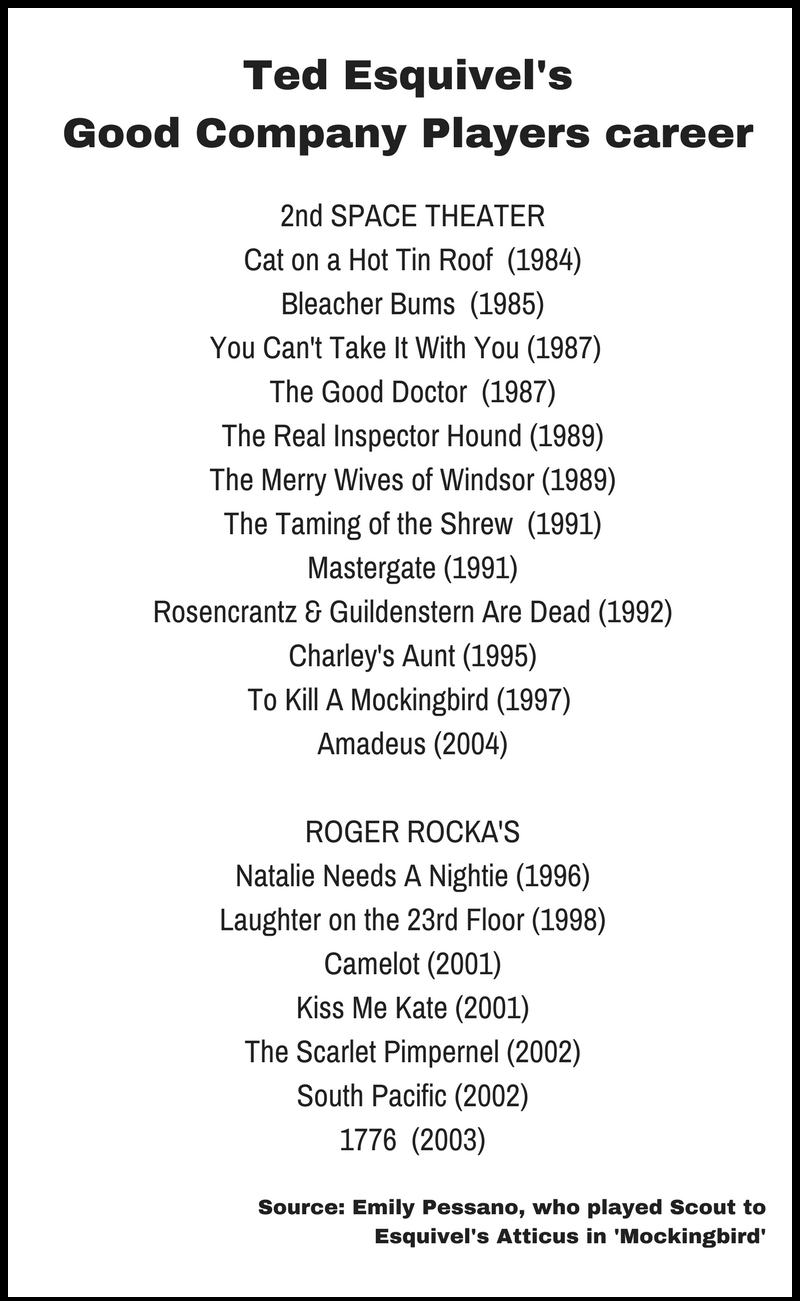
Mr. Esquivel performed at Theatre J’Nerique, Fresno City College and Woodward Shakespeare Festival. He was probably best known as a longtime veteran of Good Company Players, where people still talk about his roles in such favorite shows as ‘Rosencrantz and Guildenstern Are Dead” and “1776.”
John Masier, who worked with Mr. Esquivel on a number of productions over the years, recalls an anecdote from the 2003 production of “1776”:
He’d just had gastric bypass surgery and was losing weight. He loved it, but it also was sapping his energy as his body adjusted, and he was playing a musical lead (Ben Franklin) when we were still doing six shows most weeks. One evening he was completely exhausted before the show even started, and we knew it was going to be a long night for him.
At one point late in the show, Franklin has a particularly powerful and dramatic monologue. Ted stood up, got halfway through, then stopped, considered for a moment, and announced in the most dignified and Franklinesque voice, ‘I can no longer stand.’ He was done. He sat down, we went on with the scene, and the audience never knew they’d missed anything, or that the actor who’d entertained them for two hours could barely stay on his feet.
Eric Estep, who was also in the show, shares another story:
Sunday matinee (April 13, 2003, to be precise), our John Adams fell ill mid-show. Ted (as Ben Franklin) saved the day with at least five minutes of brilliant improvisation, asking each congressional delegate where they stood on independence.
Lindbergh spent a lot of time with her father watching him at rehearsals. (“Kiss Me Kate” and “Rosencrantz” were among her favorites.) “My dad taught me to read by cuing his lines,” she says.
She also spent a lot of time with him in the car. Her parents were divorced when she was quite young, and he’d drive her from San Jose, where she was living, to Fresno. They used to spend time on the road playing games. One of his favorites was the “questions game,” where neither could say anything but questions. “It was amazing how it could keep me entertained for hours,” she says.
Recently he had moved into senior housing in downtown Fresno. He asked his daughter for help to furnish his new unit. He died just before that could happen, most likely because of a heart condition, she says.
Her father did not lead a conventional life. Storytelling was his passion, and he found a way to make it his life’s work. “Dad didn’t have a day job,” she says. “Which is pretty unique, I think. Dad lived very simply, to say the least.”
Add to that an irreverent and playful spirit. Greg Taber, producer of the Woodward Shakespeare Festival, remembers Mr. Esquivel’s portrayal of Leonato in the first season production of “Much Ado About Nothing” back in 2005.
“He was an absolute joy and a complete treasure,” Taber says. “He would show up at rehearsal out at the amphitheater each night and wander about muttering to everyone, largely in language that you probably can’t print, and entirely facetiously, about how much he hated the whole thing, couldn’t take one more minute of it, and was going home. For a wildly disparate group of artists trying to come together to do something on the scale of WSF, he was a solid and reassuring presence.”
Jennifer Hurd-Peterson played his character’s niece in that show. She was impressed with his performance — but also something else.
“‘What amazed me more is when he came to my class and told my kids stories,” she says. “They were mesmerized.”
A memorial fundraiser has been established in his honor via GoFundMe to benefit Storyland in Roeding Park.
To subscribe to the email newsletter for The Munro Review, go to this link:
https://tinyletter.com/donaldfresnoarts