[perfectpullquote align=”right” bordertop=”false” cite=”” link=”” color=”” class=”” size=””]THEATER REVIEW[/perfectpullquote]
he Selma Arts Center production of “Sweeney Todd” didn’t settle well with me. It’s much the same reaction I’d imagine if I ate one of Mrs. Lovett’s meat pies. Though I tried, I couldn’t make much of a emotional connection to this well-meaning effort. Somehow, in the midst of an outing that boasts several great singers, Stephen Sondheim’s gorgeous score and a committed cast, the production overall seemed to me listless. Director Joseph Ham and his creative team obviously put a lot of effort into the details of this show, but some essential spark was missing.
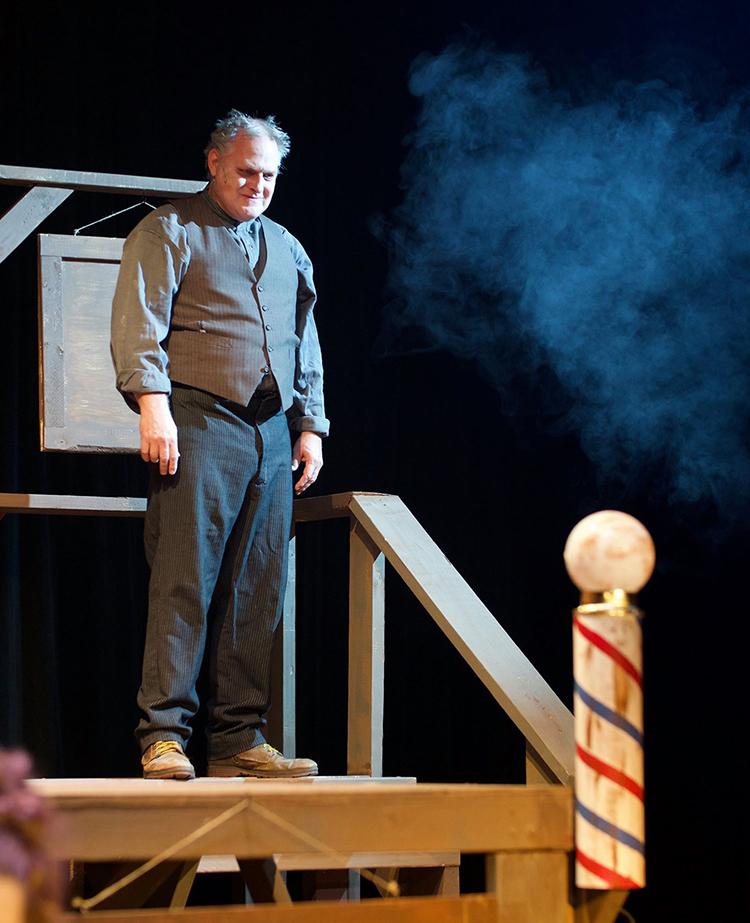
[perfectpullquote align=”left” bordertop=”false” cite=”” link=”” color=”” class=”” size=”18″]Pictured at top: Chris Carsten plays the title character in ‘Sweeney Todd.’ Photo: Selma Arts Center[/perfectpullquote]
Perhaps one factor in my sluggish response is the sluggish audience on the Friday night I attended. (And, granted, I was part of that group.) Or maybe this dark yet wickedly funny musical’s central conceit is so well known that any shock value has worn off at least three or four Johnny Depp Weird Movie Roles ago. Or it could be (spoiler alert, but does anyone really not know what happens to the victims of “The Demon Barber of Fleet Street”?) that cannibalism has been so gleefully appropriated by popular culture that it’s become Netflix-normal these days.
Some thoughts on the show:
Chris Carsten is a top-notch Sweeney. From the moment his glaring visage is highlighted in the opening scene, I could sense the vengeance pumping through him. (Even his cheekbones seem menacing.) It’s the slightest details in his performance that are most distinctive: the way he applies shaving cream with a flick and a whistle; the nearly catatonic gaze he drops into for just a few seconds at a time, as if his brain has scooted off to a wonderful place where everyone who has ever hurt him can be tortured forever; the few moments of levity when Sweeney actually seems to relax. (I love the moment when he finally “gets” what Mrs. Lovett is suggesting in terms of an interesting new supply chain for her pies.)
The acting and singing are often strong. Ben Deghand is a sturdy Anthony (his “Johanna” is gorgeous). Michael Fidalgo is a lively Pirelli (he brings a smooth confidence and a witty crackle to the stage). Kai DiMino is endearing as Tobias (with his pigeon-toed feet and clunky movements, he nevertheless brings a certain graceful whimsy to the role). And I thought it was fun to see Chase Stubblefield, a 2nd Space Theatre veteran, in a musical; his singing voice as Judge Turpin isn’t a highlight (and, then again, neither was Alan Rickman’s), but Stubblefield offers one of the more leering, creepier takes on the role I’ve seen.
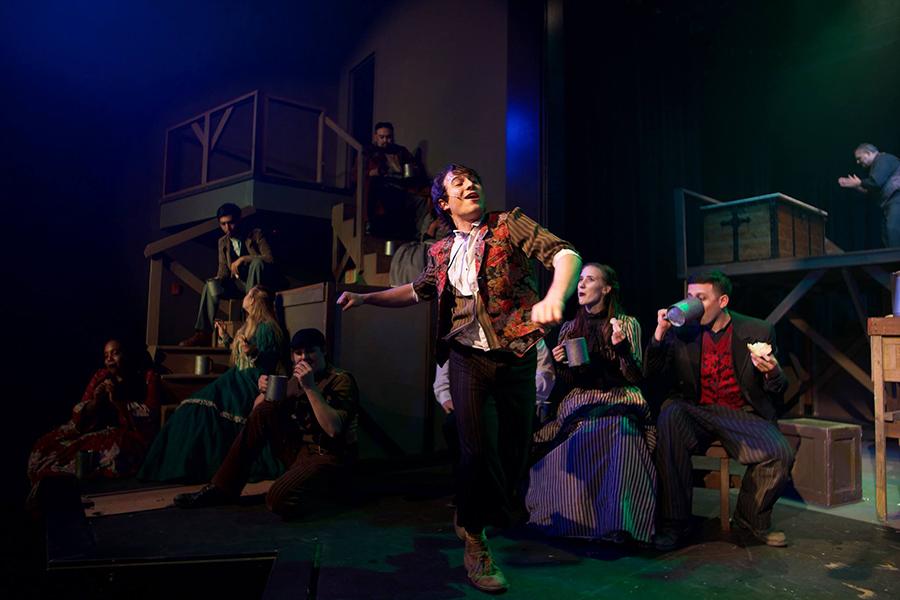
I couldn’t warm up to Emily Guyette’s Mrs. Lovett. I tried. Her singing is fine, but her laugh lines and comic moments mostly didn’t click for me. Part of this was Ham’s direction. I found some of Guyette’s physical choices distracting, almost nervous-tic-like, as she moved her hands and arms abruptly, it was too fussy and stylized. Kindle Lynn Cowger sings sweetly as Johanna, but the character seemed too detached and brittle.
The choreography tries too hard. Ham, along with Michael Christopher Flores and Deghand, as choreographers, throw a whole lot more movement into this “Sweeney” than you’d expect. The ensemble swirls, contorts, glowers and writhes on a regular basis, all with an air of gloomy psychological import. There are times when the choreography is chilling and effective, such as when the ensemble comes out in a line just before the big slaughter scene. But too often it feels obvious and forced. We get it: “Sweeney Todd” is dark. That point doesn’t need to be hammered home.
Sound and diction are issues. The recorded track often overwhelmed the singers at the performance I attended, and the mixing sounded odd, too; there were times when a single overpowering woodwind would overpower the entire string section. And some sections of dialogue were simply lost due to Cockney inarticulation and balance problems. (DiMino in particular has some issues here.)
Related story: 5 Things to Know about Selma Arts Center’s ‘Sweeney Todd’
The set is clunky. Erik Andersen and Nicolette C. Andersen’s three big set pieces — the pie shop with the barber’s quarters on top, the bake oven, and a platform suggesting a balcony — have a static feel. The stage feels cramped, and when actors make a “visit” to the bake oven, there’s little sense of a spatial relationship between the set pieces.
Two other annoyances. Johanna’s blond wig is a miss; it makes her look like a stunted Rapunzel. And what’s up with the “fancy” barber chair that Sweeney procures for his now thriving establishment? With its brass colored arms, orangeish tufted upholstery and sock-it-to-me 1960s vibe, it looks like something you’d find at Yoshi Now.
Ending on a positive note. There is some to admire in this production, from the eerie opening glow of the bake oven to the smear of dirt — or is it blood? — on the barber pole. Theo Hill’s period costumes offer a top-hat elegance mixed with street-grime rawness. In terms of the suspense, I still felt some sizzle, particularly in Sweeney and Judge Turpin’s final scene together. And, again, Carsten is just terrific.
Why, though, my overall lackluster response? I can think of another possibility: that “Sweeney” is just too bleak for the dark and pessimistic era we’re navigating through today. In more optimistic times, when humankind seems to have a brighter future, a bit of wicked-fun Sondheim bleakness can seem like a raucous, amusing distraction. When the world outside the theater doors feels more like “man devouring man,” perhaps an order of tonsorial takeaway hits a little too close to home.
Show info
“Sweeney Todd,” a Selma Arts Center production. 7 p.m. Thursday, Oct. 17; 7 p.m. Friday, Oct. 18; and 2 and 7 p.m. Saturday, Oct. 19. Selma Arts Center, 1935 High St., Selma. Tickets are $19 general, $17 students and seniors.